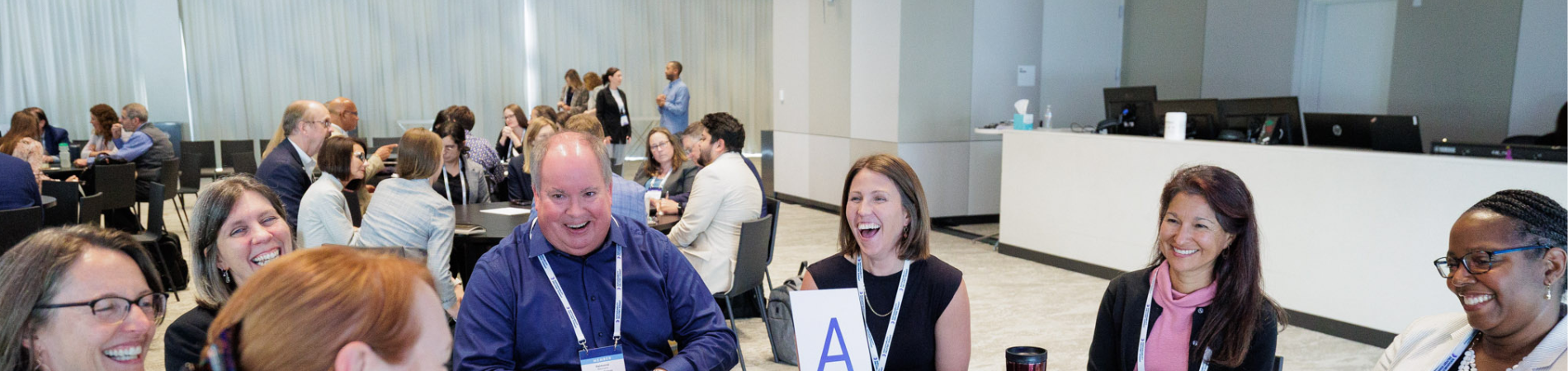
Interactive Roundtable Discussions
This session is an opportunity to break out into small groups to discuss challenges and explore best practices and innovative strategies relevant to each subject area. Attendees choose one topic discussion to participate in.
A. Beyond “Green Add‑Ons”: Making Integrated Sustainability Core to Project Delivery and Societal Outcomes
Sustainability is too often treated as an additional layer of project delivery — something considered once scope, budget, design, and commercial decisions are already set. This roundtable will explore how organisations can move beyond “green add ons” and embed sustainability into the core of project decision- making and delivery from the outset. Participants will be invited to share their own practical insights in discussing how sustainability can shape project scope, design choices, delivery models, governance, client conversations, and measures of success - helping to deliver stronger environmental, social, and long-term value outcomes.
The RT will also examine the practical barriers that prevent integration, including timing, skills, accountability, client expectations, and commercial pressures, before identifying practical enablers that can help make integrated sustainability standard practice across projects.
Andy Goddard, European Service Line Leader - Site Solutions & Market Director - UK Environment & Health, Ramboll
B. Resilient Infrastructure: Summer Heat Wave as a Policy Delivery Test
Recent heatwaves and extreme weather events have highlighted the growing challenge of climate resilience across transport, energy and other critical infrastructure systems. While resilience is now embedded in many policy frameworks, real-world events provide a valuable test of whether those policies are delivering the intended outcomes.
Using the summer heatwave as a case study, this roundtable will explore what recent disruptions reveal about the strengths and weaknesses of current policy approaches. Participants will consider how resilience requirements are translated into planning, investment and operational decisions, and whether existing governance and regulatory frameworks support effective adaptation.
The session will focus on lessons learned, opportunities for policy improvement and the practical actions needed to strengthen infrastructure resilience in the face of increasing climate risks.
Christine Wissink, Technical Director, Carbon and Climate, WSP
C. From Landscape to Cityscape: Scaling Nature Recovery in Urban Places
This RT will explore the financing, incentives and delivery mechanisms needed to increase green and blue infrastructure in urban environments, as well as the wide-ranging environmental, social and economic benefits these investments can generate. Drawing on contributions from attendees, existing research and practical examples, we will discuss how local nature recovery can be delivered in practice, highlighting the distinct opportunities and challenges associated with urban areas, different to large landscape-scale recovery initiatives.
Eilish Halford, Principal Consultant, Nature Advisory, WSP
D. How Do We Better Integrate Climate Risk Management into Investment and Design Decision-Making?
Climate change is forcing a fundamental rethink of infrastructure decision making. The assumptions that have underpinned investment, design and asset management for decades are being challenged by more frequent extreme weather, changing risk profiles and growing pressure to deliver resilient infrastructure at pace.
This AtkinsRéalis roundtable will explore how organisations can make climate risk a core part of investment and design decisions rather than an afterthought, helping to unlock investment, reduce long-term costs and build confidence in major infrastructure projects. Bringing together industry leaders and decision makers, the discussion will focus on practical action, sharing insights on how resilience can be designed in from the outset to support sustainable growth and long-term infrastructure performance.
Francis Heil, Associate Director - Climate Change & Resilience, AtkinsRéalis
E. Collaborating Across the Supply Chain for More Sustainable Solutions
Right now, sustainability can get lost in our procurement cycles. Clients don’t know the right questions to ask, struggle to get minimal supplier data or don’t see their sustainability requirements passed down the supply chain. Suppliers are faced with hundreds of different data requests, with little value attached to their sustainability performance and no way to highlight more sustainable solutions. Yet supply chains offer the real solutions to tackling Scope 3 and wider sustainability challenges.
This RT will explore ways to connect, standardise and simplify supply chain collaboration which is essential for sustainable development.
Luke Deamer, Group Sustainability Director, Keller
F. Building a Vision for Integrated Infrastructure Resilience
This summer, we have witnessed the fragility of some of our most critical infrastructure systems, from energy to rail, and the cascading impacts that can arise when they fail. These disruptions demonstrate how climate risks rarely sit neatly within the boundaries of a single asset, organisation or sector, yet decisions about the future are still often made within those same limits.
Through the lens of rail, this cross-sector roundtable will explore what a resilient, connected infrastructure system could look like in 2050 and the ambition needed to achieve it.
Áine Ní Bhreasail, Associate, Arup
G. Optimising Partnerships & Collaborative Relationships for Effective Project Delivery
Many large infrastructure projects are delivered through collaborative relationships which enable delivery partners to combine their skills and expertise and enhance the value proposition and cost-effectiveness of the project. However, this also requires a joint understanding of possible challenges and considerations that need to be included from the outset.
This RT will explore the importance of early contractor involvement and collaboration, as well as effective risk- and knowledge-sharing that encourages openness, transparency, and trust between stakeholders. It will also discuss how to ensure that sustainability, social value, resilience, and whole-life considerations are incorporated at the very early stages of planning, design, and procurement to clearly define requirements and responsibilities and ensure project objectives are aligned with organisational and environmental goals.
Stronger partnerships can directly improve project outcomes, reduce risk, and deliver greater value across the project lifecycle.
Kate Lloyd, Sector Group Manager, Civil Engineering Contractors Association (CECA)
H. Delivering Industrial Decarbonisation for Growth and Resilience
This RT will explore the hard-edged enablers of industrial decarbonisation and competitiveness: accelerating infrastructure development, strengthening investment drivers, fast-tracking technology deployment, advancing market reform, and building workforce capability.
It will discuss how to balance the removal of immediate delivery barriers with the strategic management of long-term structural shifts, to map a practical pathway for a low-carbon industrial base.
Jason Howlett, Chief Executive Officer, Energy Storage Association UK
I. Rethinking Sustainability: Building the Business Case Through Metrics and Strategic Communication
This will be a roundtable focused on the need to appropriately frame sustainability in an era marked by uncertainty and volatility, and how the business case for it becomes clearer. It will aim to draw on insights around the table on how this can be done and offer a perspective on what constitutes best practice for sustainability and why it offers critical tools in terms of risk management, efficiencies and long-term stability.
Signe Norberg, Director of Policy and Public Affairs, Institute of Sustainability and Environmental Professionals (ISEP)